
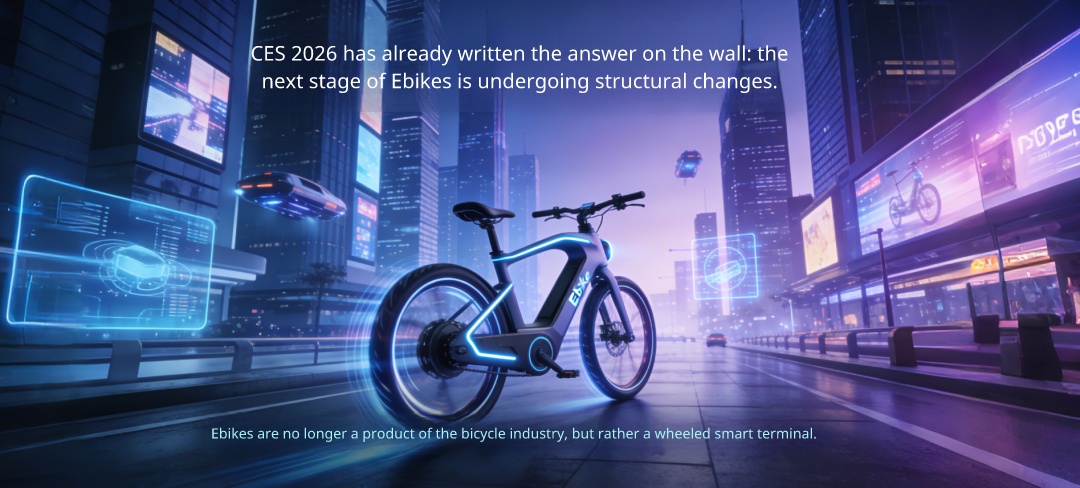
If you carefully reviewed all the Ebike-related releases at CES 2026, you would notice a harsh but undeniable reality:
Ebikes are no longer just products of the “bicycle industry.”
They are being redefined as—
A smart terminal with wheels + part of the micro-mobility infrastructure.
And this shift isn’t happening in three to five years—
It’s starting right now, in 2026.
I. The First Major Blow from CES 2026 to the Ebike Industry:
“Smart Features” Are No Longer a Bonus—They’re the Entry Ticket
Here’s a hard truth:
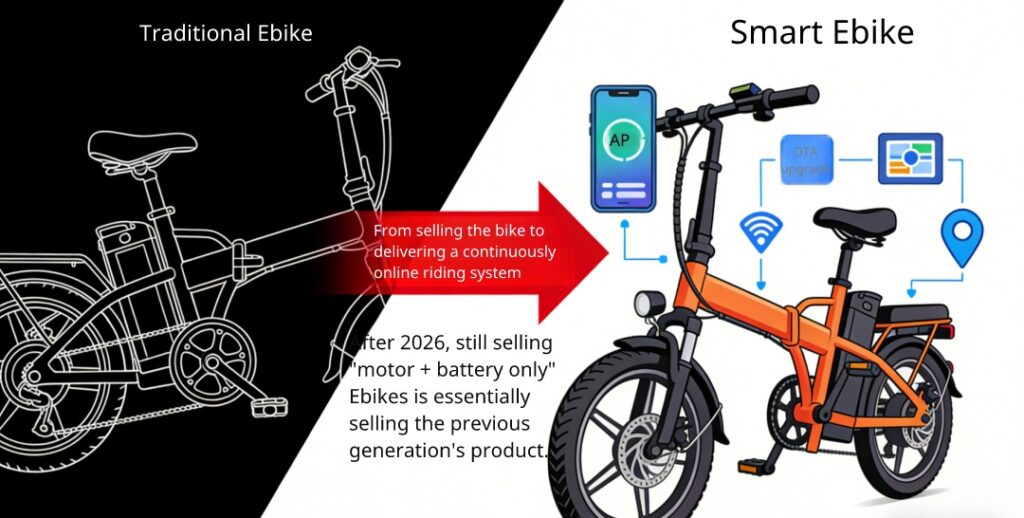
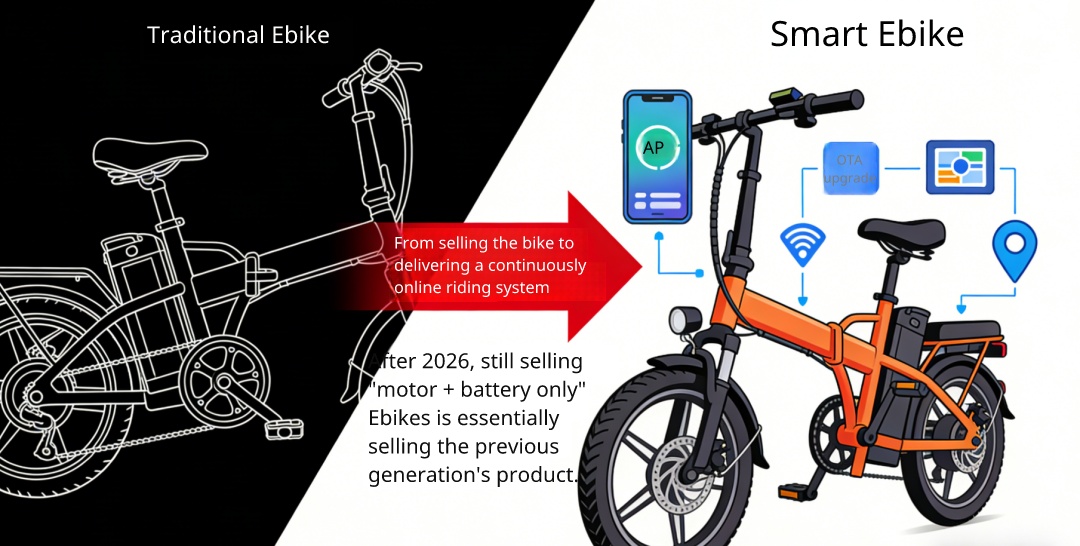
After 2026, selling Ebikes that are “only motor + battery” is essentially selling last-generation products.
At this year’s CES, almost every Ebike solution showcased was focused on the same things:
-
APP connectivity
-
OTA updates
-
GPS positioning
-
Anti-theft systems
-
Ride data recording
-
System-level control logic (not just individual components)
In other words,
The entire vehicle is becoming “systematized.”
A clear trend is emerging:
The shift is from “selling a vehicle” to “delivering a continuously online riding system.”
The implications for the industry are:
-
Hardware margins will continue to shrink
-
Software, services, and data will become the long-term value drivers
-
The relationship between users and brands will change from a one-time transaction to a long-term connection
This step is precisely the same logic as when smartphones replaced feature phones.
II. The Second Strong Signal:
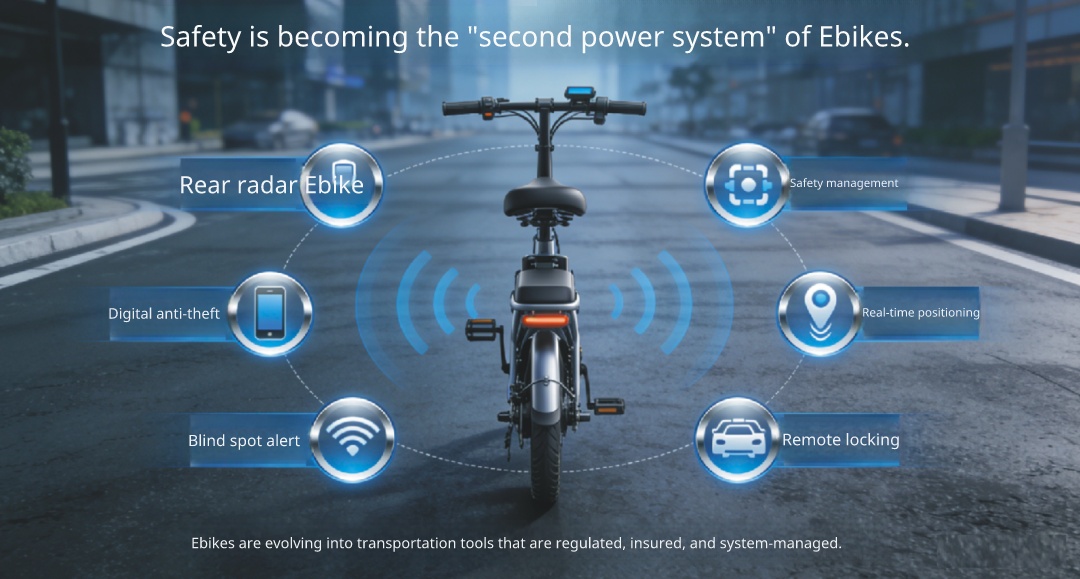
Safety is Becoming the “Second Power System” for Ebikes
What has been the industry’s biggest fear in recent years?
-
Battery fires
-
After-sales service being uncontrollable
-
Regulatory risks
-
Accident liability
At CES 2026, a very clear direction emerged:
Safety technology is becoming automotive-grade.
This includes, but is not limited to:
-
Digital anti-theft
-
Real-time location tracking
-
Remote locking
-
Rear radar
-
Blind spot warnings
-
System-level safety management
Where have we seen these technologies before?
In cars.
Now, they are trickling down to Ebikes.
What does this mean?
Ebikes are evolving from “riding tools” into “regulated, insurable, system-managed means of transportation.”
For brands, sellers, and the supply chain, this is a double-edged sword:
III. What CES 2026 is Really Telling You:
Ebikes Are Splitting into Multiple “Specialized Species”
If you still define an Ebike in one sentence—
“It’s just a power-assisted bicycle,” then you are at least two years behind the market.
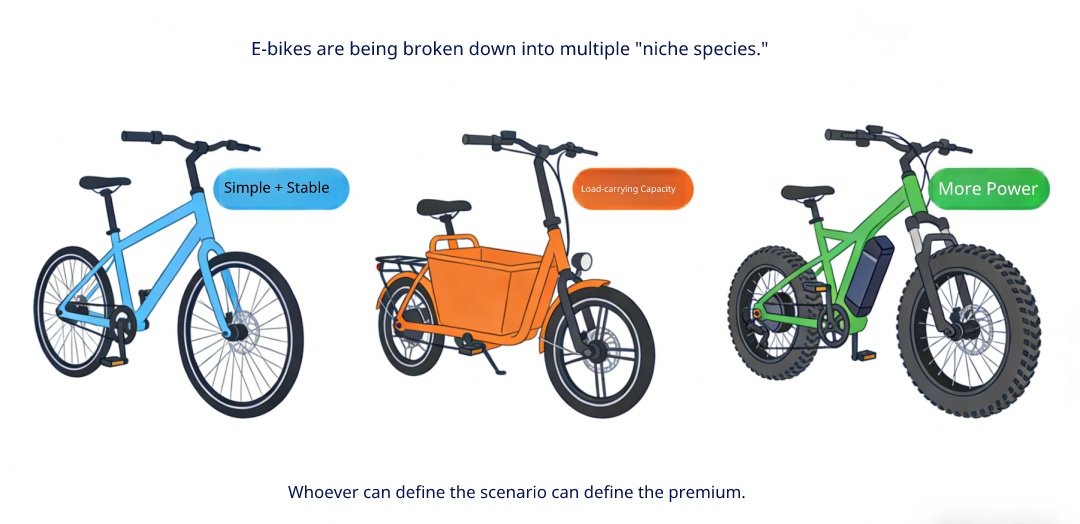
A very obvious change at this CES was the segmentation:
1️⃣ Urban Commuter Ebikes
-
Keywords: Simple + Reliable
-
Target: Non-cycling enthusiasts
-
More like a “household appliance”
-
Easy to use, low learning curve
2️⃣ Cargo / Utility Ebikes
-
Load-carrying capacity is emphasized
-
Target: Food delivery, family use, urban logistics
-
Essentially targeting the “last-mile” market
3️⃣ Off-road / High-Performance / Light e-Motorcycle Borderline Products
-
Higher power
-
Stronger structure
-
Occupying the grey area between Ebikes and e-motorcycles
The real change behind this is:
The Ebike market is transforming from a “single category” into a “collection of scenario-specific products.”
Whoever can define the scenario can define the premium.
IV. A Key Change Many Missed, But It’s Crucial:
Ebikes Are Being “AI-fied”
You might think talking about AI is cliché now.
But at CES 2026, some brands have started integrating AI genuinely into the riding experience:
-
Voice interaction
-
Route recommendations
-
Learning riding habits
-
Optimizing assist control logic
Pay attention, this isn’t just a gimmick.
Its real significance is:
Vehicle control is starting to shift from “rule-driven” to “data-driven.”
Once this is achieved, the future core competitiveness of Ebikes will not just lie in:
-
Whose motor is used
-
Whose battery cells are used
But rather in:
-
Who understands the user better
-
Whose data is more comprehensive
-
Whose system is more mature
This is a very real warning for pure OEM players.
V. What About Batteries?
CES 2026 Didn’t Focus on Them, But the Industry is Quietly Changing the Foundation
Although the focus of this CES wasn’t primarily on Ebike batteries themselves, you need to read the “subtext”:
-
Energy density is still improving
-
Safety standards continue to tighten
-
Requirements for structure, battery packs, and consistency are getting higher
What does this mean?
The future gap between Ebikes will likely not be in the “battery cell brand,” but in the “system-level battery capability.”
This includes:
-
BMS
-
Consistency control
-
Structural safety
-
Lifecycle management
Batteries are transforming from a “cost item” into a “risk item + competitive item.”
VI. The True Revelation of CES 2026 for the Ebike Industry Summarized in One Sentence
If it must be distilled into three points:
-
Ebikes are transitioning from the “bicycle industry” to the track of “smart hardware + mobility systems.”
-
Price wars are not the endgame; system capabilities, compliance, and scenario-specific capabilities are the future barriers.
-
After 2026, the industry will increasingly polarize—the low-end will be squeezed, the high-end will be systematized, and middle-ground players will be in the most danger.
A Final Word for Industry Insiders
CES is never just for spectacle.
Its real value lies in:
Writing out the industry’s direction 1-2 years in advance.
If you are currently involved in:
-
Ebike branding
-
Cross-border e-commerce sales
-
Supply chain platforms
-
Batteries / Motors / Structural components
Then you must seriously consider one question:
When Ebikes become “system products,” what irreplaceable value do you provide in this chain?
This is a question that, starting in 2026, can no longer be avoided.
Bestseller #1
Bestseller #2
Bestseller #3
